
Registering trademarks enables brand owners to stop others from using their trademarks and to prevent public confusion about the source of goods or services. However, certain exceptions permit the use of another’s trademark to describe the user’s products or services (as illustrated in Section 30 of the Trade Marks Act, 1999: Limits on the effect of a registered trade mark).
Continue reading “Descriptive Use as a Defense to Trademark Infringement in India”Tag: India

Simplicity Is No Bar: Delhi HC on Inventive Step and Amendments
The Delhi High Court in Dong Yang PC, Inc. v. Controller of Patents & Designs [C.A. (COMM.IPD-PAT) 60/2024], on 1 July 2025, considered an appeal under Section 117A against a Section 15 refusal of 2554/DEL/2013 (“Vertical Rotary Parking System”). A pre-grant opposition filed against the application had cited documents D-1 to D-4, and shortly before the hearing, an additional prior art document, D-5, was introduced. In response, the applicant filed Form-13 seeking to amend the application in reliance on Sections 57-59. The Controller, however, rejected the proposed amendments and refused the application on the ground that the claimed invention lacked inventive step under Section 2(1)(ja), describing the claimed features as no more than a “mere workshop modification.”
Continue reading “Simplicity Is No Bar: Delhi HC on Inventive Step and Amendments”
Delhi High Court upholds refusal under Section 3(k) but sets aside Section 59 objection
The Delhi High Court in Kroll Information Assurance, LLC v. Controller General of Patents, Designs & Trade Marks upheld refusal under Section 3(k) but set aside the Section 59 objection.
In the present case, the Court considered an appeal under Section 117A from a refusal of Indian Patent Application No. 8100/DELNP/2007 (by order dated 25 June 2019) titled “A System, Method and Apparatus to locate at least one type of person, via a peer-to-peer network.” The prosecution history included objections under Section 2(1)(j)/2(1)(ja), Section 10(4)(c), Section 3(b), and Section 3(k), with a hearing-stage objection to amendments under Section 59/Section 57; the Controller ultimately refused under Section 59, Section 2(1)(j), and Section 3(k).
Continue reading “Delhi High Court upholds refusal under Section 3(k) but sets aside Section 59 objection”Dr. Ramesh Kr. Mehta Speaks at NSIL-2025 on Academia-Industry Collaboration
Dr. Ramesh Kr. Mehta delivered an invited talk at the National Summit of Institutional Leaders (NSIL). The event was held at Doon University on March 1, 2025. He explained how Patenting by Academia will help in developing the Industry-Academia Collaboration.
Continue reading “Dr. Ramesh Kr. Mehta Speaks at NSIL-2025 on Academia-Industry Collaboration”Akshay Mehta Invited to Judge the Philip C. Jessup International Moot Court Competition – India Round 2025
We are pleased to share that Akshay Mehta was invited by the Jessup Committee to judge the prestigious Philip C. Jessup International Moot Court Competition – India Round 2025. The competition was held from February 12-15, 2025, at The Amity Law School, Noida, India.
Continue reading “Akshay Mehta Invited to Judge the Philip C. Jessup International Moot Court Competition – India Round 2025”
Celebrating 20 Years of Excellence in IP Protection!
As we mark two decades of dedicated service in intellectual property law, we extend our heartfelt gratitude to our clients, partners, and team members who have been part of this journey.
Continue reading “Celebrating 20 Years of Excellence in IP Protection!”
Delhi High Court Sides with ADIDAS in Dismissing Claim of Prior Use
The Delhi High Court granted a permanent injunction and monetary damages against the defendants in Adidas AG (plaintiff) v. Keshav H. Tulsiani & Ors (defendants) [CS (COMM) 582/2018], restraining them from manufacturing, selling, marketing, or trading textile goods under ADIDAS marks or any other deceptively similar marks.
Continue reading “Delhi High Court Sides with ADIDAS in Dismissing Claim of Prior Use”
World Intellectual Property Indicators 2024 places India in global top 10 for patents, trademarks and industrial designs
On 12 November 2024, India’s Press Information Bureau reported key outcomes from WIPO’s World Intellectual Property Indicators 2024, confirming India’s position among the global top 10 across patents, trademarks and industrial designs. In patents, India posted the fastest year-on-year growth among the top 20 origins in 2023 (+15.7%), totaling 64,480 applications with a resident share of 55.2%, and a 149.4% year-on-year increase in patent grants. Industrial design applications rose by 36.4%. In trademarks, India ranked fourth globally for filings; the Indian trademark office holds the second-largest number of active registrations worldwide (over 3.2 million), with resident filings accounting for nearly 90%.
Continue reading “World Intellectual Property Indicators 2024 places India in global top 10 for patents, trademarks and industrial designs”Court Emphasizes Reasoned Decisions: Regeneron Pharmaceuticals Inc vs. Controller of Patents and Designs
The Madras High Court, via judgement dated October 22, 2024, in Regeneron Pharmaceuticals Inc vs. Controller of Patents and Designs [(T)CMA(PT) No.191 of 2023] addressed an appeal under Section 3(b) and 59 of the Patents Act (Act) by Regeneron Pharmaceuticals challenging the Indian Patent Office’s (IPO) refusal order dated December 16, 2020 issued in respect of their Indian Patent Application No. 1554/CHENP/2013.
Continue reading “Court Emphasizes Reasoned Decisions: Regeneron Pharmaceuticals Inc vs. Controller of Patents and Designs”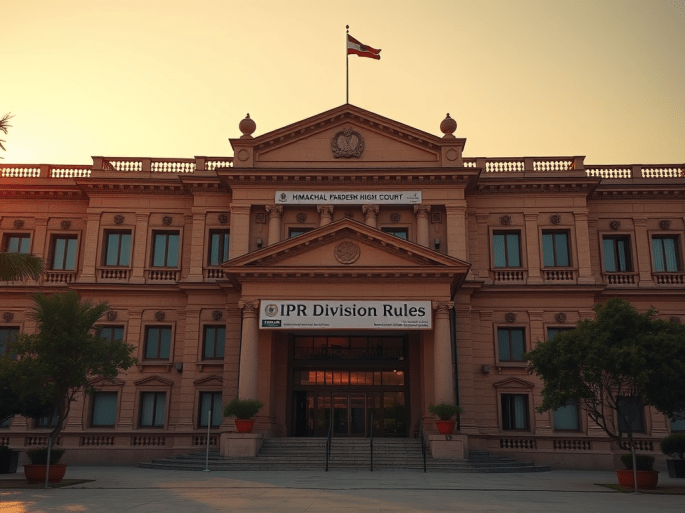
The Himachal Pradesh High Court becomes the 4th High Court in India to notify IPR Division Rules
The Himachal Pradesh High Court on 8 July 2024 notified its Intellectual Property Rights Division Rules, 2022. The official copy of the said rules can be viewed here Notified IP Rules
Continue reading “The Himachal Pradesh High Court becomes the 4th High Court in India to notify IPR Division Rules” MehtaIP